PD Client and GDB (NL)
Manage all your NVWA declarations easily and error-free, automate processes and ensure full compliance within your supply chain.

A report on the EurTradeNet annual meeting, detailing exactly what changes are being made to European customs law.
On September 10 and 11, we gathered in Athens with just under fifty colleagues from all over Europe. Not with clients, not with prospects, but with the people who do exactly what we do here in their own countries: build customs software. Greeks, Poles, Germans, Scandinavians, Italians, Spaniards, Slovenians, Czechs, and Irish. Our Greek fellow member, Orian Information Systems, served as our host.
The theme of the two-day event was “From Here to There, Joining the Dots.” That sounds like a conference slogan, but it summed up the agenda perfectly. The first half focused on where we stand today, covering all the challenges of ICS2, NCTS6, and the elimination of the exemption for small shipments. The other half focused on where we’re headed, with the reform of the Customs Code, the EU Customs Data Hub, and the new European customs authority.
The timing was no coincidence, but it turned out to be more precise than expected. While we were in Athens, the legislative process was entering its final stretch in Brussels and Strasbourg. The Council had already given its final approval on September 3. The European Parliament followed suit on September 16, thereby making the most far-reaching revision of EU customs law since the establishment of the customs union in 1968 a reality.
Stream Software is a member of EurTradeNet, or ETN for short. This is a European association of software companies that develop customs declaration systems and act collectively in dealings with DG TAXUD and other European authorities. For a Benelux-based company like ours, this isn’t just a networking group. It’s the place where you find out what’s happening in the other twenty-six member states before it reaches us, and the place where the industry collectively addresses issues that you can’t resolve on your own.
The latter is less abstract than it sounds. When the rollout of ICS2 stalled, it wasn’t just one supplier that brought this to the Commission’s attention. This was done jointly with the shippers’ and freight forwarders’ associations, all the way up to the level of the Directorate-General. You see the same pattern now with regard to the e-commerce rules.
We’ve been in the customs sector for a long time, and we plan to stay there for a long time to come. That means we can’t limit ourselves to what needs to go into production next month. The reform that has now become law will remain in effect through 2034. Anyone who doesn’t understand how the Data Hub works today will be building the wrong things in the coming years.
That is why I am writing this report. What follows is an account of those two days, interspersed with the background information you need to understand why it matters. Everything included here comes from publicly available sources: the Official Journal, official documents from the Commission and the Council, communications from the European Parliament, and the public tender dossier. Anything discussed confidentially within the association remains confidential.
The first sessions focused on the legislative timeline—and on how short it had suddenly become.
Theoretical Framework: Where Does the Reform Stand Now?
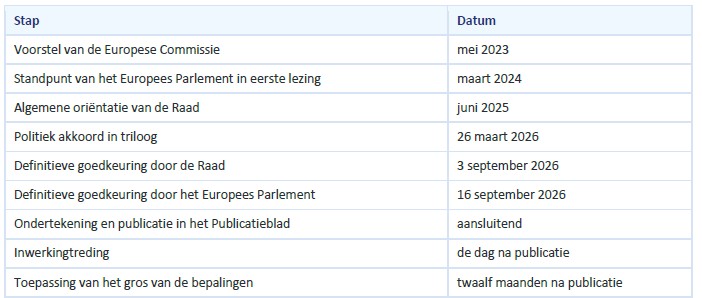
Note the distinction between those last two lines. The regulation takes effect the day after its publication, but most of its provisions do not take effect until twelve months later. These two points are often confused in media reports.
The EU Customs Authority (EUCA) will be legally established the day after the agreement enters into force. Its headquarters will be in Lille. That’s barely a two-hour drive from the Benelux countries, which could prove quite relevant in the long run.
It is important to understand that the reform itself is a framework law. The actual details will be set out in delegated and implementing acts that are only now being drafted. Five priorities have been announced: the European e-commerce settlement fee, the “Trust and Check” status and the associated import process, the Data Hub, risk management, and EUCA-related aspects. The target date for the Data Hub functionalities, access rights, the “Trust and Check” application process, and the import process for importers in distance sales is July 1, 2027.
What this means in practice
The broad outlines have been established, but the exact details of what you will need to provide are currently being finalized. That is precisely why the sector responsible for its implementation is trying to remain involved in the discussions.
This was the session where the audience was most engaged, and that makes sense. This part of the reform is already working.
The 150-euro exemption has been eliminated
Council Regulation (EU) 2026/382 of February 11, 2026, repeals Chapter V of Title II of Regulation 1186/2009. As of July 1, 2026, shipments with an intrinsic value of up to 150 EUR are no longer exempt from customs duties. The reason is stated in the regulation itself: the threshold allowed for systematic abuse through undervaluation and the artificial splitting of shipments.
To put this into perspective: according to the Commission, 5.9 billion low-value items entered the EU in 2025. More than 90 percent of e-commerce packages came from China.
The 3-euro fee, and the three nuances that are usually overlooked
There is a lot of inaccurate information circulating about this, including in the mainstream media. Three things in the brief summary are incorrect.
It is temporary. Article 2 of Regulation 2026/382 establishes the rate from July 1, 2026, through July 1, 2028. It is a transitional measure, not a new permanent rate.
This does not apply to everyone. The 3 EUR fee applies in two cases: when the import is VAT-exempt under Article 143(1)(c-a) of Directive 2006/112—that is, when using the IOSS scheme—or when the goods are sent by mail. For economic operators who are not registered for IOSS, the standard Common Customs Tariff continues to apply. This is explicitly stated in Recital 6.
It is calculated per item, not per package. In the Q&A accompanying the guidelines of June 30, 2026, the Commission clarifies that the fee is applied per declaration line. Operators are encouraged to use one line per type of goods with the same tariff classification in an H7 declaration. A shipment containing five different items therefore does not incur a fee of 3 EUR, but rather five times 3 EUR.
And then there's the clause that isn't discussed nearly enough
Regulation 2026/382 provides for two review periods.
Starting October 1, 2026, the Commission will assess on a monthly basis whether there is a shift in trade flows—in particular from IOSS to non-IOSS—to avoid the flat-rate fee. If it determines that such a shift is occurring, it may propose extending the measure to all goods in shipments valued at up to 150 EUR.
No later than December 1, 2027, the Commission will assess whether the centralized European IT infrastructure will be operational by July 1, 2028. If not, it may propose extending the transitional measure.
Read that last part again:
. The end date for the 3-euro fee depends on whether the technology is ready on time. For us, as the builders of that technology, that’s not just a footnote—it’s the core of the assignment.
What we're seeing in practice in the meantime
The figures that have been made public confirm what our customers have been experiencing since the summer: a sharp decline in e-commerce volumes since July 1, a halving of the number of shipments, and a clear shift from H7 to H1. That shift is not always in accordance with the regulations, and the Commission has indicated that it will first evaluate the change in flow before taking any action.
For those who file tax returns, this means three specific things that are already in effect today.
Delegated Regulation (EU) 2026/1022 of June 30, 2026, also sets forth the definitions, declarations, and related data elements.
A second measure that will take effect this fall. The reform introduces a fee for each item sold directly to an EU consumer from a third country, to cover the additional costs incurred by customs authorities due to the growing number of individual packages.
Three things are publicly known. The Commission sets the rate by delegated act and reviews it every two years. Member States will begin collecting the fee as soon as their IT systems are operational, and in any case no later than November 1, 2026. And the fee will be paid by the same entity that is liable for the other customs duties on that package—a deliberate choice by the co-legislators to prevent the cost from being passed on to the consumer.
That second sentence deserves special attention from those who file returns in multiple member states. “As soon as the IT system is operational” means that the effective start date and the practical implementation may vary by country. We have therefore not hard-coded this but set it up to be configurable, precisely because we assume that Belgium, the Netherlands, and Luxembourg will not implement this at exactly the same time or in exactly the same way.
Perhaps the most fundamental change in the entire reform—and the one that has been discussed the least.
Sellers and platforms that facilitate distance sales from third countries to EU consumers are treated as importers. This requires them to provide customs with all necessary information, pay or guarantee payment of the duties owed, and ensure that the goods comply with EU rules. These parties must be established in the EU or represented by an entity established in the EU with AEO status or Trust and Check status. This requirement is explicitly in place to prevent shell companies from circumventing the rules.
There is a provision in there that carries significant weight in practice. The importer must ensure that the goods comply with other legislation enforced by customs. However, this obligation does not apply to an importer who is represented by an indirect representative established in the Union, provided that such representative is an AEO or a “Trust and Check” entity.
For customs representatives
Indirect representation is a role that involves a barrier to entry and actual liability. Anyone who takes on this role assumes a compliance burden that would otherwise fall on the foreign seller. This presents a commercial opportunity, but also a risk that you must be able to document.
In cases of systematic non-compliance, the reform provides for sanctions: financial fines, suspension or revocation of trusted trader status, possible temporary restriction of access to the online interface, classification as a high-risk operator in the Data Hub, and suspension of the release of goods. For the most serious cases, fines can amount to 6 percent of the previous year’s annual import value. The exact thresholds will be set out in a delegated act.
One slide that brought the room to silence was a simple list. According to DG TAXUD, the legislation that customs helps enforce comprises more than 350 items. REACH, classification and labeling of chemicals, batteries, biocides, construction products, cosmetics, critical raw materials, cultural goods, deforestation, drug precursors, dual-use items, ecodesign, energy labeling, fertilizers, firearms, fluorinated greenhouse gases, general product safety, forced labor, intellectual property rights, medical devices, toy safety, waste, and trade in wild animals and plants. And that’s just a sampling.
The guiding principle of the reform is that imported goods should be subject to the same rules and, ideally, the same controls as goods produced within the EU, and that goods entering the EU via e-commerce should be treated in the same way as traditionally imported goods.
In 2025, the Commission, together with market surveillance authorities, carried out a coordinated inspection campaign targeting four major B2C marketplaces. More than 30,000 items were inspected, revealing high rates of non-compliance.
As far as we’re concerned, this is where the workload is shifting the most. Not toward more customs declarations, but toward being able to demonstrate that a product is allowed to enter the country. And in many organizations, the expertise on this matter isn’t found in the customs department, but in procurement or with the supplier. Bridging that gap will take years, not just one software release.
Now for the big one: the EU Customs Data Hub.
One authority, one platform
The starting point for the reform is to eliminate fragmentation. Today, 27 national customs authorities operate using more than 111 separate IT systems. These will be replaced by a single European customs authority in Lille and a single central platform, whereby data will, in principle, be submitted only once and be usable throughout the Union. The EUCA manages the Data Hub, conducts risk analysis at the European level, and establishes priority control areas and common risk criteria.
For common goods of low value, the thousands of possible tariff categories will be reduced to four, which will significantly simplify the calculation of duties on small packages. The Commission expects the new e-commerce regime to generate approximately 1 billion EUR per year in additional customs revenue.
The Timeline
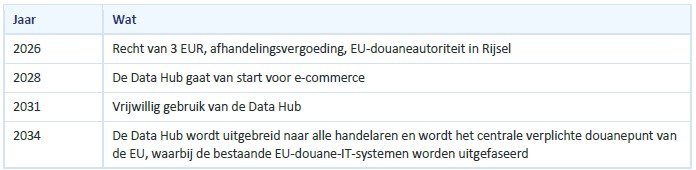
The key planning message of this entire dossier is
: Eight years between the first mandatory implementation and full compliance. There is no single moment when everything switches over all at once.
What the RFP Reveals
One of the most useful sessions focused on a document that anyone can read but that almost no one does: the call for proposals for the E-commerce Data Hub. DG TAXUD published it on June 8, 2026, with reference number EC-TAXUD/2026/CD/0007 and an estimated value of 136,320,000 EUR, excluding VAT. It is a competitive dialogue involving up to four selected candidates and ultimately one contractor, for a 48-month framework contract. Signing is scheduled for March 2027, and the role of contracting authority may later be transferred to the EUCA.
That document provides more insight into how the system will work than the text of the law itself. Three points stood out.
It is a hybrid model, not a replacement for everything. The Data Hub provides the common European processing layer: calculation of entitlements, checks for prohibitions and restrictions at the EU level, risk management, and the orchestration of releases for free movement. National systems will continue to exist for country-specific matters such as national rules regarding prohibitions and restrictions, specific national taxes, payments, accounting, collateral, and national risk processes. The Hub sends the relevant dataset to a national system and receives the result back as an event, which is then processed within the overarching process.
That is the sentence that matters most to us. The question that has been circulating in the industry for two years now is whether national customs systems will eventually disappear. The answer provided in the public record is more nuanced: they will not disappear; they will become federated processing services within a larger system.
The architecture is event-driven. Legal events do not occur in a fixed order. Processes arise from the choreography of those events and from business rules. This is fundamentally different from the traditional filing process, in which a single document must be complete at a single point in time.
The scale is substantial. The reference benchmark in the dossier indicates approximately 300 billion transactions per year, peaks of around 6 million messages per minute, a system-to-system response time of less than 2 seconds, and an availability of around 99.9 percent. In addition, strict sovereignty requirements apply: every entity involved must be based in the EU, including its executive management, without control or significant influence from a third country, must meet at least SEAL-3 under the EC Cloud Sovereignty Framework, and must store and process personal data within the EU.
If there was one session that stood out to us, it was the review of ICS2. Not because it was a flawless success story, but because the challenges were openly acknowledged and listed by the Commission itself.
ICS2 has been fully rolled out as of June 1, 2026, following a five-year transition period. The scale is impressive: approximately 360 million ENS declarations and transport documents per year, 12.5 ENS declarations per second with real-time risk assessment, 655,000 border checks, and 400,000 shared risk assessments between member states. The results are tangible. According to national authorities, data quality has improved significantly, particularly in air and maritime transport. Joint real-time risk assessment across multiple countries within the same supply chain is effective, resulting in more seizures.
Notably, the list of points for attention hardly mentioned legislation at all.
The specific lessons for the Data Hub were accordingly. Prepare early and test well in advance. Train staff at all levels, because this is a process transformation, not an IT project. Have national authorities treat the Hub as their own system, not as something external. Ensure equivalent service levels and 24/7 support. Enforce harmonized standards so that there is no incentive to enter through the most lenient member state. And above all: no “big bang” approach, but a phased transition by transport sector and business model.
We also urge our users and other economic operators to ask your industry associations to submit a formal request to Customs to establish working groups where the implications of the EU Customs Reform can be actively discussed. The more knowledge and insight that can be disseminated and shared, the better!
The practical lesson
The legal deadline is not your real deadline. Your real deadline is the moment when you need to be able to test.
One of the sessions touched on a topic that is often overlooked in customs circles: eFTI, the European framework for electronic transport information, which falls under the purview of DG MOVE rather than DG TAXUD.
The eFTI Regulation (EU) 2020/1056 requires competent authorities to accept regulatory transport information electronically when operators submit it via certified eFTI platforms. The framework covers road, rail, inland waterway, and air transport. The effective date is July 9, 2027.
The architecture mirrors that of the Data Hub. Business data remains stored on certified eFTI platforms. Authorities retrieve only the subset they need for a specific inspection via national eFTI Gates. There is explicitly no central European freight database.
Some of the secondary legislation is already in place: Implementing Regulation 2024/1942 on access and processing by authorities, Delegated Regulation 2024/2024 on the common dataset, Delegated Regulation 2024/2025 on national information requirements, and Implementing Regulation 2025/2243 on the requirements for eFTI platforms. Still to come, with a target date of December 2026: the requirements for service providers and the certification rules for platforms and service providers.
So, there are two European data structures, with two opposing design philosophies, that must be supported by the same companies. In the long term, there is potential for gain by eliminating duplicate reporting between transportation and customs. In the short term, this primarily means that 2026 and 2027 will each have two implementation windows.
We spent Friday morning in smaller working groups, all focusing on the same three themes: what has changed in UCC practice since last year, how everyone is preparing for the reform, and what role our sector will play in a world of advanced analytics and AI.
What is discussed there stays within the association. We are happy to share what we take away from it ourselves, because that is exactly what guides our work.
The question is shifting from “Is the filing correct?” to “When will the data be complete and submitted at the right time?” In an event-driven system, there is no longer a single moment when a single document is submitted in its entirety all at once. Data comes in from different sources and at different times. Someone must determine when the file is complete and ensure that determination is reliable. That is a fundamentally different problem from validating tax returns, and it is not something you can simply tack onto an existing system as an extra field.
Operational readiness is becoming more important than the statutory deadline. Experience with ICS2 has shown that early testing, clear escalation procedures, and timely communication during outages are more important than missing functionality. This applies to both authorities and companies. In practice, anyone connecting customers to a central European system becomes their first point of contact, and you need to be organized for that before it happens.
AI changes the way we work, not our responsibilities. There was broad consensus that AI speeds up work—both in development and in support—and equally broad consensus that a human must remain in the loop to handle exceptions and perform random checks. The tender document succinctly articulates this principle: AI speeds things up; people make the decisions.
We are a Benelux player in a process that is being shaped on a European scale. A straightforward interpretation of the 2034 plan is that a central European platform could, in principle, render a national tax filing software provider obsolete. We believe that interpretation is too simplistic, and the public procurement documents support that view.
The target model consists of a common European core with national extensions. National systems remain responsible for national bans and restrictions, national taxes, payments, accounting, and collateral, and communicate with the Hub via events. This means that, well into the 2030s, two layers will coexist, and someone will need to ensure that those two layers work together.
That’s what we’re focusing on. Not just sitting out the 2028–2034 window, but making the most of it. Specifically, for us, that means the following in the coming months:
We will continue to monitor this closely, both within ETN and in our discussions with local customs authorities. If you’d like to know what this means for your shipments, we’d be happy to discuss it with you.

